
The 5 Keys
Five memorable, practical things you can work on every day.
1. Look Up
Look 5–10 metres ahead when you walk. It sounds simple, but looking down is one of the most common habits that increases fall risk.
Looking up keeps your centre of gravity over your feet, gives you perspective against the horizon, and reduces sudden course corrections. If you have a stiff neck, scan rather than stare. Upright posture actually changes your hormones for the better.
Quick check: Stand naturally and look at where your thumbs are pointing. If they point inward or backward, your shoulders are rounding forward — a sign your upper body posture needs work.
Exercises
- Chest lift: Stand tall, lift your chest as if someone attached a string to your sternum.
- Chin tuck: Gently draw your chin back (making a "double chin") to straighten the upper spine.
- PERCH sitting: Sit on the front edge of your chair, feet flat, spine tall — practice daily.
- Band exercise: Resistance band behind your back, pull outward to open chest and shoulders.
2. Toes Up
If you can't lift your toes properly, you're going to trip. Ankle stiffness is one of the strongest predictors of falls — and it responds really well to stretching.
A study of 54 people over 60 found that ankle stiffness predicted who would fall. A 2021 study identified three key differences between fallers and non-fallers:
- Lack of ankle dorsiflexion (lifting the foot up)
- Loss of big toe extension
- Foot pain
Tight calves make it harder to get out of a chair, climb stairs, and squat. They're also linked to back problems and peripheral neuropathy.
The Knee-to-Wall Test
Stand facing a wall with your heel on the ground and toes 10cm from the wall. Can you touch your knee to the wall without lifting your heel? If not, your ankle mobility needs work. A 60-second daily calf stretch has been shown to significantly improve this.
Exercises
- Ankle lifts: Stand or sit, lift toes up toward shins. 20 reps, 3 times daily.
- Calf stretch: Hold 60 seconds, best done at end of day. Wall or step stretch.
- Big toe stretch: Gently pull big toe up and hold for 30 seconds.
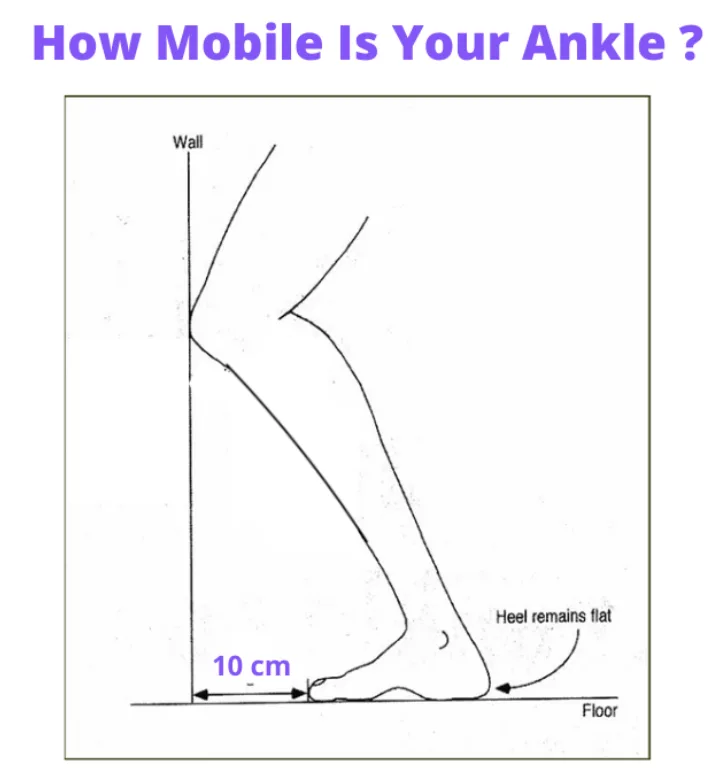
The knee-to-wall test
3. Arms Up
Your arms aren't just along for the ride. A good arm swing helps you maintain balance, reduces the waddle, saves energy, and maintains speed. Swing from the shoulders, forward and backward.
If you do lose your balance, strong arms can break a fall. Landing on your side is 5.5x more likely to cause a hip fracture — strong arms help you control how you land. Landing on your back or front reduces fracture risk by 3.6x. Using a walking aid also reduces fracture rates. It's not cheating, it's engineering.
Exercises
- Rag doll: Stand and let your arms hang loose, then swing gently side to side.
- Wall/bench push-ups: 3 sets of 10–15, push and pull movements.
- Band pulls: Use a resistance band for shoulder strengthening.
4. Speed Up
Slowing down usually makes you more likely to fall, not less. Below 1 metre per second (3.6 km/h), your fall risk increases by 1.5x. Above that threshold, risk reduces by 1.4x.
"People don't get older then slow down — they slow down THEN they get older."
Gait speed is now considered a "vital sign" for older adults. Research from the BJSM shows type 2 diabetes risk decreases significantly at walking speeds above 4 km/h.
Walking speed and diabetes risk relationship
Walk to the beat
Match your steps to songs at the right tempo:
- 90 bpm: "The Lazy Song" — gentle warm-up
- 100 bpm: "I'm Still Standing" — good pace
- 110 bpm: "Stayin' Alive" — brisk walking
- 120 bpm: "Another One Bites the Dust" — power walk
The irony of "Another One Bites the Dust" as a walking song is not lost on us.
One exception: do slow down when changing direction or on uneven surfaces. Hurrying is involved in 14% of falls, and changing direction in 20%. Speed is good — but not when you're dodging the cat.
Don't overstride
When your foot lands too far ahead of your body, it acts as a brake. You lose energy, increase impact on your joints, and actually slow yourself down.
Listen to your feet. If your steps are noisy, you're landing too hard. Noise equals shock, and shock equals joint injury over time.
The fix is simple: land your foot under your body, not in front of it. Shorter, quicker steps are both safer and more efficient than long strides. Think of it as rolling forward rather than reaching forward.
5. Stay Up
80% of walking is spent on one leg. If you can't balance on one leg for at least 7 seconds, your walking will suffer. 15 seconds is good, 30 is excellent.
The decline starts with losing confidence on one leg, then widening your base, developing a waddle, shuffling, and holding onto things. Sound familiar? It's reversible.
Key principle: when you lose your balance, learn to step, not grab. Research shows fallers tend to cross their legs when off balance, while non-fallers step sideways.
Balance exercises (at the kitchen bench)
- Three positions: Leg in front, leg level, leg behind — hold 7–30 seconds.
- Tandem stand: Feet heel-to-toe, then progress to walking heel-to-toe.
- Tightrope walks: Heel-to-toe in a straight line.
- Reach and step: Reach forward, then take a controlled step.
- Step-overs: Step over small objects for dynamic balance.
Progress from static to dynamic balance — 5–10 minutes per day.
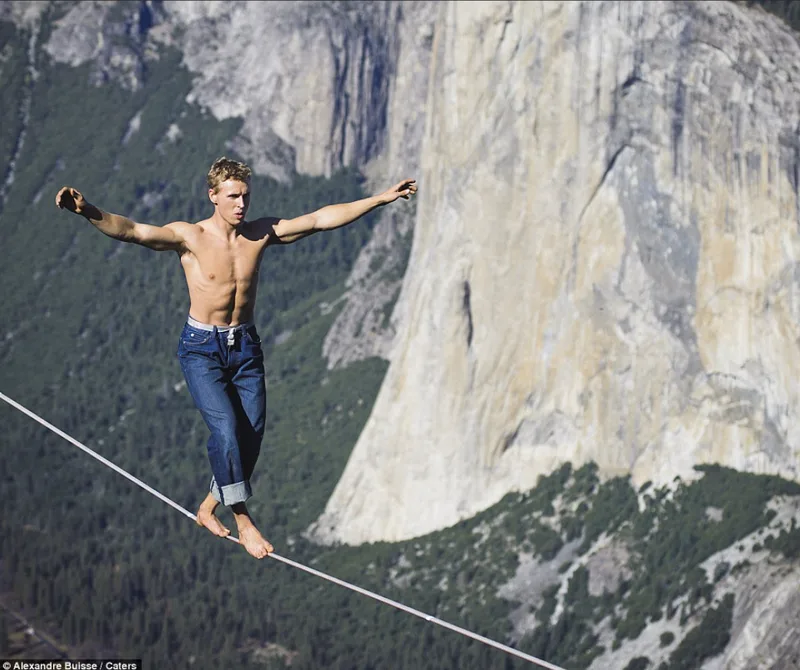
Tandem (heel-to-toe) standing
"Stop crossing your legs when you sit. It trains your brain to move your knee across your midline — exactly the wrong reaction when losing balance sideways. Yes, it looks sophisticated. No, your hip doesn't care."
Ready to walk the talk?
Join Alan's next workshop, or book an appointment to work on your specific goals.